Artificial intelligence
A topical commentary on AI as an amplifier that can't tell brilliance from mediocrity.
AI's impact depends on the technology itself.
AI's impact depends on what kind of world you point it at: an amplifier of brilliance in one, of mediocrity in another.
Sutherland's running distinction is between "thin tailed" activities, where AI mostly makes existing mediocrity a bit cheaper and a bit more consistent, and "fat tailed" ones, where it can amplify a rare moment of human brilliance far faster than before. The technology itself doesn't decide which kind of world you're using it in.
He's specific that AI can explain a joke very well but can't originate one, and worries the technology will be used overwhelmingly for cost and headcount reduction rather than genuine value creation, not because it can't create value but because that's the easier story to tell a finance department. He half jokingly names the two groups he'd least like to see get their hands on it: terrorists, and chief financial officers.
This is the most exposed theme in the archive to simple obsolescence. Commentary on a fast moving technology risks reading as dated far sooner than his psychology rooted material, and it's the one area where Sutherland is speculating outside his actual expertise rather than reporting from it.
63 verified insights in this theme
63 verified insights in this theme
Rory's joke about who is most likely to misuse AI as a pure cost-cutting tool.

Pull-quote arguing that natural-pace speech (e.g. voice dictation) promotes politeness in a way typing does not.
Rory criticizes AI features imposed on users purely to let companies report adoption statistics to financial analysts, rather than to serve the user.

On people using AI chatbots like a horoscope or oracle to offload a hard decision.

On why people distrust a human expert's gut instinct but readily trust an AI's.
On the limits of building a data dashboard that claims to model complex human behaviour.
On an AI image classifier (per an anecdote from Tim Harford) that hallucinated an animal in pure white noise, and the human parallel (pareidolia).
Rory extends a famous economists' analogy about factory electrification to argue that organizations take decades to redesign work around new technology, in conversation with Josh Hart and Elfried Samba.
Rory argues that AI's lack of reputational stakes means humans will retain a role as the accountable party when AI output goes wrong.
Rory summarizes the limitation of AI trained only on historical data, contrasting human awareness of gaps in knowledge with AI's blindness to what it hasn't seen.
Rory illustrates the idea that valuable creative output is often produced speculatively rather than commissioned, as part of his speculation that AI could flip advertising's commission model.
Rory relays advice from an AI advisor to the Commonwealth, arguing people should hold nuanced, ambivalent views of AI rather than unquestioning love or hatred.
Rory uses the typewriter as an example of technology adopted for appearances rather than productivity, warning that some AI adoption may follow the same pattern.
Rory questions the opportunity cost of trillions of dollars in AI investment relative to healthcare, roads, and welfare spending.
Drawing an analogy for AI: new technology changes what becomes newly worthwhile to pursue.

Extending the steam-engine analogy directly to AI: new capability changes what's worth creating.
Explaining Jevons' paradox and why he hopes it will apply to creativity as AI lowers production costs.
Warning that whichever part of a business controls AI adoption determines whether it's used for savings or growth.
A joke illustrating his fear that finance-driven cost-cutting mindsets will misuse AI's potential.
On where the real risk of AI adoption originates.

On how AI tends to get sold into organizations.
On needing a search engine aligned with the user's interest rather than an advertiser's.
Extending the quantification-bias point to AI and large language models.

Discussing the 'ick factor' and the limits of AI reasoning, leading into the wrongful-conviction nurse case.
Applying the contrarian-betting principle to AI investment.
Concluding the detective-work/information-weighting discussion with a concern about AI training data.
On the double standard toward human versus AI-generated creative intuition.
Continuing on why AI-generated creative work is, paradoxically, easier to sell internally than equally good human work.
Applying the explore/exploit distinction to two contrasting uses of AI.

Contrasting the fat-tailed AI use above with a thin-tailed, efficiency-only use of AI.
Connecting Adam Smith's warning about the demoralizing effects of divided labor to a modern Silicon Valley phrase about algorithmic hierarchy.
Concluding the doorman fallacy point about consultants redefining human roles to fit automation.
Responding to a question about whether the 'right brain' can win against relentless optimization, turning to AI as an example.
Continuing his answer on AI, warning that AI's economics will push firms toward cost-cutting over value creation because it's the easier sale.
Explaining why AI is likely to be sold to corporations on the promise of immediate cost savings regardless of accuracy.
On the tribal, football-team-like way people treat AI, good or bad.

Closing warning about how technology narratives, including AI, are used to justify cutting value-creating investment.
On why humanities training may matter more, not less, as AI automates technocratic skills.

Continuing on AI and imagination, arguing that asking good questions becomes the scarce skill once answers are automated.
On why call centers should be improved, not automated away, in the AI era.

On the threat AI poses to hourly-billed professional services.
On how AI should ideally be deployed in organizations.
Framing the two possible uses of AI in business.
On AI's limits in original creative generation versus explanation.
Testing AI's ability to understand versus generate humor with his own joke.
Explaining why AI's attempted joke failed despite understanding the original joke's structure.
Drawing the general conclusion that AI can assist but not originate breakthrough creative ideas.
Summarizing AI's role as an assistant to, not a replacement for, human creativity.
Continuing the critique of the double standard applied to AI versus human decision-making.
Rory speculating on how AI-driven search could flip advertising: instead of businesses finding consumers, consumers appoint AI agents to find things to buy.
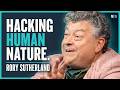
Rory continuing his point that AI search could invert the advertising model, from businesses reaching consumers to consumers deploying agents to find products.
Rory summarizing his inverted-advertising thesis for an AI-agent-mediated economy.
Comparing how people should treat AI-generated suggestions to how drivers treat satnav directions.

Arguing that the normalization of video calls, not AI, was the most consequential behavioral shift of recent years.

On underrated video-conferencing technology relative to the AI conversation.

Closing question about what "slow AI" would look like.
Explaining why models that avoid blame end up stripping out human psychology entirely.

Arguing that AI-generated essays destroy the part of the process that actually held the value.
Rory explaining his actual concern about AI: cost-driven adoption logic, not existential risk.

Illustrating why an averaged solution is inherently uncreative and dull.

Rory on the doorman fallacy and how tech firms misdefine jobs to justify automating them

Warning that unlike physical-world temptations, algorithmic targeting has no ethical sense and will hunt for behavioural vulnerabilities online.

On why recognition software must be calibrated to occasionally misfire (pareidolia) to work well at all.